教育理念
Philosophy
The Sora Method
Soraメソッド
The Sora Method is our own educational method, developed by studying in depth the early childhood philosophies the world has come to value, among them Montessori education and the Reggio Emilia approach, and advancing them through practice in Sora's own classrooms. What the Sora Method nurtures is SMILE, the non-cognitive skills a child needs for the times ahead: Social Skills, Manners, Interests, Languages, and Enthusiasm. We grow them through the daily environment rather than by instruction.
Soraメソッドは、モンテッソーリ教育やレッジョ・エミリア・アプローチなど、世界的に評価されてきた幼児教育思想を深く研究し、Soraの保育現場での実践を通して発展させた独自の教育メソッドです。Soraメソッドが育てるのは、これからの時代を生きる子どもに必要な非認知能力「SMILE」(Social・Manners・Interests・Languages・Enthusiasm)です。教え込むのではなく、毎日の環境を通して育てていきます。

The Five Abilities We Nurture
Soraが育てる5つの力
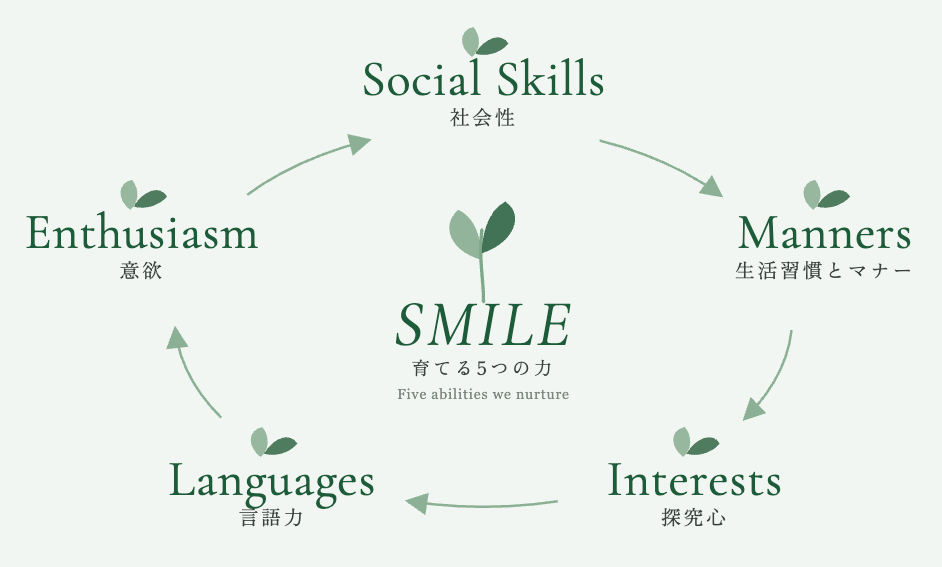
Social Skills(社会性)
The students learn appropriate communication skills that are essential to establish decent relationships with diverse individuals.
心からの思いやりをもって人と接し、よりよい関係を築いていける社会性を育みます。
Manners(生活習慣とマナー)
The students learn to make manners, in the form of greetings and table manners at meals, an ingrained habit.
美意識をもとに、あいさつや食事など、日常におけるさまざまな生活習慣とマナーを身につけさせます。
Interests(好奇心と自己表現)
The students learn to value their curiosity, initiate learning opportunities on their own, and express themselves, which fosters an attitude that opens up possibilities for their futures.
好奇心を大切に、みずから学び、表現し、未来への可能性を広げていく姿勢を育みます。
Languages(言語と多文化理解)
The students develop global awareness through learning multiple languages and understanding diverse cultures by being exposed to them.
国際的な感性を養い、多様な文化への理解を言語を修得し、世界の人々と向き合い、理解し合える語学力を育みます。
Enthusiasm(意欲)
The students develop a proactive attitude while building confidence and driving themselves to pursue their interests.
自信をもって考え、行動し、その先に出会った疑問や興味に対して、粘り強く追求する意欲と熱意を育みます。
Well-balanced Education
バランス教育
Whenever we work with a child, one principle guides our judgment. We call it well-balanced education.
子どもと向き合うとき、Soraにはひとつの判断の軸があります。それがバランス教育です。
In raising a child, one side alone is never enough. Sora keeps three balances in mind.
子どもを育てるうえで、「どちらか一方だけでいい」ということはありません。Soraでは、次の3つのバランスを大切にしています。
Freedom and discipline
自由と規律
Expressing yourself freely, and learning discipline within a group.
自由に表現することと、集団の中で規律を学ぶこと。
Individuality and cooperation
個性と協調
Valuing each child as an individual, and working together with friends.
一人ひとりの個性を大切にすることと、友達と協力すること。
Intellect and sensibility
知性と感性
Deepening intellectual learning, and growing the ability to feel and to be moved.
知的な学びを深めることと、感じる力や心の動きを育てること。
In daily life these balances come up everywhere: stillness and movement, play and learning, self-expression and the rules of the group. Rather than choosing one side, we watch each child, check for any tilt, and adjust so that they grow in balance as a whole.
日々の保育では、静と動、遊びと学び、自己表現と社会のルールなど、さまざまな場面でこのバランスが求められます。どちらか一方を選ぶのではなく、子どもの様子を見ながら偏りが出ていないかをたしかめ、全体としてバランスよく育つように調整しています。

Above All, Sora Cares About the Learning Environment
Soraが何より大切にしているのは、環境です

Physical Environment
物的環境
A clean classroom with walls in one color. Visitors are often struck the moment they walk in. We do not paper the walls with posters, so children can settle and focus. Materials sit at a height children can reach, so they can choose for themselves and put things away for themselves.
壁の色を統一した清潔な教室。見学に来られた方が、教室に入った瞬間に驚かれる空間です。ポスターをベタベタ貼らず、子どもが集中できる空間です。教材は子どもの手が届く高さに置き、自分で選んで、自分で片づけられるようにしています。
Language Environment
言語環境
Not lessons, but a daily life in which Japanese and English are both simply present. Each adult speaks only one language with the children, and the two are never mixed. Through picture books, songs, and seasonal events, children meet both Japanese and American culture.
レッスンではなく、生活の中に日本語と英語がどちらも自然にある毎日。ひとりの大人はひとつの言語で子どもに接し、言葉を混ぜません。絵本や歌、季節の行事を通して、日本とアメリカの文化にふれます。
Human Environment
人的環境
The calm manner of the teachers. An atmosphere where a child can start over after a mistake, and feel safe enough to relax. Because they feel safe, learning goes in deeply.
先生の穏やかな関わり。失敗してもやり直せる、安心してリラックスできる空気。安心できるから、学びが深く入っていきます。
Physical environment
物的環境

Language environment
言語環境

Human environment
人的環境
Why Both Languages Grow Here
日本語と英語が、どちらも育つ理由
In every Sora classroom, a teacher who speaks Japanese and a teacher who speaks English work side by side. Each adult speaks one language and never mixes the two. Children learn to choose their language by looking at the person in front of them, without ever being taught to.
Soraの教室には、日本語で話す先生と、英語で話す先生が一緒にいます。ひとりの大人はひとつの言語で話し、言葉を混ぜません。子どもは相手を見て言葉を選ぶことを、教わらなくても覚えていきます。
Japanese, inside daily life
日本語は、毎日の生活の中で
At Sora, Japanese is in the greetings, the picture books, the songs, the play, and the seasonal events, and there are friends who speak it. Unlike a weekly class, children are in contact with Japanese across the whole day, every day.
Soraでは、あいさつ、絵本、歌、遊び、行事のすべてに日本語があり、日本語で話す友達がいます。週に一度の教室とちがい、毎日の生活全体で日本語にふれます。
English, in the same classroom every day
英語も、毎日の教室で
A teacher who speaks English is in the classroom every day as well. Children from Japanese-speaking homes spend their days playing and talking in English too, well before they move up to kindergarten.
英語で話す先生も、毎日教室にいます。ご家庭の言葉が日本語のお子さんも、キンダーガーテンに上がるまでに、英語で遊び、英語で話す時間を重ねていきます。
The Same Language, Until It Gets Through
伝わるまで、同じ言葉で
The Japanese-speaking teacher stays in Japanese and the English-speaking teacher stays in English, all the way through. When something does not get across at first, the teacher uses expression, gesture, real objects, and pictures. Because the teacher does not switch, the child stays in contact with that language, and in time begins to use it.
日本語の先生は日本語で、英語の先生は英語で、最後まで伝えます。すぐに伝わらないときは、表情、身振り、実物、絵を使います。先生が言葉を切り替えずにいるから、子どもはその言葉にふれ続け、やがて自分から使いはじめます。
A Single Word Comes Back as a Sentence
ひとことを、文にして返す
When a child says just "water," the teacher gives it back as a full sentence: "May I have some water, please?" For "I don't get it," the teacher offers "Could you show me?" The habit of repeating the teacher's words grows a way of speaking that truly reaches people.
子どもが「水」と言ったら、先生は「お水をください」と文にして聞かせます。「わかんない」には「教えてください」。先生の言葉をまねして言ってみる習慣が、きちんと伝わる話し方を育てます。
Language Lives Inside the Activities
言葉は、活動のなかで
Japanese and English are used across art, music, numbers, letters, and time with friends. Morning circle time happens in both Japanese and English, and afternoon circle time in Japanese. Teachers speak in careful, polite language, and children use their voices, move their bodies, and share their own ideas.
日本語と英語は、アート、音楽、数、文字、友達との関わりのなかで使います。朝のサークルタイムは日本語と英語の両方で、午後は日本語で。先生は丁寧な言葉で話し、子どもは声を出し、体を動かし、自分の考えを話します。
Confidence and Pride in Both Languages
どちらの言葉にも、自信と誇りを
For a child whose main language is English, we make chances to meet Japanese and Japanese culture. For a child whose main language is Japanese, we make chances that ease any hesitation toward English. We work from where each child's language is today. Our teachers share a saying: "Keep talking to them, and pour into the cup of words one drop at a time. One day the cup fills and overflows."
英語が中心のお子さんには、日本語と日本の文化にふれる機会を。日本語が中心のお子さんには、英語への抵抗感をやわらげる機会を。一人ひとりの今の言葉を見ながら関わります。先生たちには合言葉があります。「あきらめずに話しかけ、1滴ずつでも言葉のコップに水を注ごう。そうすれば、いつかコップの水がいっぱいになって溢れる」。
A Curriculum That Starts with About Me
About Meから、世界へ広がるカリキュラム
Sora's curriculum begins with About Me. Children learn what they love, who their family is, and what surrounds them, and from there the learning widens to friends, to the town, to the world. It gives a five-year-old a first reason to wonder what kind of person they are.
Soraのカリキュラムは「About Me(わたしのこと)」から始まります。自分の好きなもの、家族、まわりの世界を知り、そこから友達へ、町へ、世界へと学びが広がっていきます。5歳の子どもが「自分はどんな人間だろう」と考えるきっかけをつくる学びです。


Make it yourself, then eat it
自分の手でつくって、食べる
Testing "why?" for real
「なぜ?」を実際に確かめる
Choosing, then using your hands
自分で選び、手を動かす
Japanese Culture and the Turning Seasons
日本の文化と季節の行事も、大切に
Hinamatsuri, Tanabata, moon viewing. Halloween, Thanksgiving, Christmas. We travel through the events of both countries across the year, in song, in craft, and in food. Time in Japanese, preparation for reading and writing hiragana, and manners for greeting and eating are part of every day here. For the children, both become their own culture.
ひな祭り、七夕、お月見。ハロウィン、サンクスギビング、クリスマス。ふたつの国の行事を、歌と工作と食べもので一年かけてめぐります。日本語の時間、ひらがなの読み書きの準備、あいさつや食事のマナーも、園の毎日の中にあります。子どもにとっては、どちらも「自分の文化」になります。


Hinamatsuri
ひな祭り
Summer festival
夏まつり
Halloween
ハロウィン